
Interesting astronomy facts
October 23, 2009 | In: Space Facts
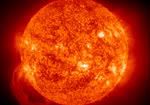
The Sun is around 4.5 billion years old.
The center of the Sun is called the core.
There are stars that are over 600,000 times as bright as the Sun.
The biggest star is VY Canis Majoris, a red hypergiant 5000 light years from the Solar System.
Mercury can be as cold as 300 degrees below zero.
One day on Jupiter is only 9 hours and 55 minutes.
Earth’s galaxy, the Milky Way, contains about 400 billion stars.
There are nine identified planets in our solar system. They are in the order as they appear moving towards from the sun, Mercury, Venus, Earth, Mars, Jupiter, Saturn, Uranus, Neptune, Pluto.
Every year the moon is moving away from the Earth by 3 cm.
A lunar eclipse is the opposite of a solar eclipse.
Light from the sun takes 8 minutes to reach you, thus you see the sun as it was 8 minutes ago.
Proxima Centauri is the closest star to our solar system and is nearly 4 light years away.
If you could travel at the speed of light (186,000 miles per second) it would take 100,000 years to cross our galaxy!
Earth doesn’t take 24 hours to rotate on its axis. It’s actually 23 hours, 56 minutes and 4 seconds .
Lots of people, in fact about 13% of those asked in 1988, still believed the Moon to be made of cheese.
Saturn’s rings consist mostly of chunks of ice, ranging in size from microscopic (too small to see) grains to boulders as big as a house.
The study of Saturn’s rings began with Galileo’s discovery in 1610, and continues today with the help of the Voyager spacecraft and the Hubble Space Telescope.
You can identify the planets by looking for these colors:
* The Sun is bright yellow.
* Mercury is white.
* Venus is dull yellow.
* Earth is blue.
* Mars is red.
* Jupiter is pink.
* Saturn is yellow and far from the sun.
* Uranus is light blue.
* Neptune is blue and far from the sun.
* Pluto is purple.
The times around the sun are true scale to each other. The distances apart from each other and the sun are also true scale (except that the outer planets; Jupiter, Saturn, Uranus, Neptune, and Pluto have been cut in half (that is, they would need to be twice as far to be to scale).
The sizes of the planets are true to relative scale (not actual scale as they would be less than a pixel) except: Jupiter, Saturn, Uranus and Neptune are 2x their true relative radius. Pluto is about 35x its true radius (since Pluto is so tiny). The sun is also not to scale.
You might also like
 |
 |
|
 |
2 Responses to Interesting astronomy facts
admin
July 10th, 2010 at 3:46 am
Why do planets look like stars in the night sky?
Stars are producing their own light just as our sun (which is merely the closest star to us) is producing light. But the stars are very, very far away from our solar system so they appear to be very tiny even though they are large. The planets are much closer. They are within our solar system. Although they are small, they appear to be about the same size as the stars because they are so close to us. However, the planets don’t produce their own light. They reflect the light of the sun in the same way our moon reflects sunlight.
admin
July 26th, 2010 at 11:25 am
Titan, a moon of Saturn, has an atmosphere that is similar to Earth’s in the period when life was first emerging on our planet.
Titan is the only satellite in our solar system with an atmosphere.