
Interesting whale facts
October 22, 2009 | In: Animal facts for kids
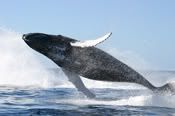
Scientists believe that early whales actually walked the earth. The theory, supported by recent fossil finds in the foothills of the Himalayas, is that about 53.5 million years ago, whales were amphibious. (source)
Whales are not fish; they are ocean-dwelling mammals. Like other mammals, they breathe with lungs, give birth to live young and produce milk.
Warm-blooded and highly intelligent, whales possess a special sense called echolocation that helps them navigate through the murky depths of the ocean using sound.
There are 79 to 84 different species of whale.
The blue whale is the largest whale. A blue whale can reach lengths up to 100 feet and weigh as much as 30 elephants.
The blue whale’s heart that weighs 1,300 lbs and only beats about ten times per minute.
The humpback whales males produce, in frequencies between 20 and 9,000 Hz, songs that are the longest and the most varied in all the animal kingdom, with repeated sequences about 15 minutes long.
Bowhead Whale (Balaena mysticetus) is a baleen whale that lives only in the Arctic and is rich in blubber.
Baleen whales are characterized by having no teeth; instead, they have baleen plates for filtering food from water.
Whales are closely related to dolphins and porpoises.
A humpback whale may eat up to a ton of food every day.
Whales love to sing! They use this as a call to mates, a way to communicate and also just for fun!
The beluga whale has a flexible neck allowing it to move its head. In contrast, other whales have the vertebrae of their necks fused together.
The beluga whale’s flexible neck helps it to scan the bottom for worms, crustaceans, and mollusks, and to catch swimming fish and squids.
Adult beluga whales are almost white in color. They are 10-16 feet (3-5 m) long and usually weigh one to one and a half tons. They are found all around the North Pole, off the coasts of Scandinavia, Greenland, the former Soviet Union, and North America.
Belugas are among the most vocal of whales. They make a variety of sounds including clicks, moos, squeaks, trills, and twitters, which can be heard both above and under water.
Historically, whales were hunted for their meat, bones, baleen and oil, until some larger species were pushed close to extinction. The International Whaling Commission voted to ban all commercial whaling in 1986, and although this has given whales a chance to recover, they are still at risk from illegal hunting, pollution and other dangers.
You might also like
 |
 |
 |
 |
1 Response to Interesting whale facts
admin
August 3rd, 2010 at 7:52 am
Of all animals, the blue whale has the largest babies. Baby blue whales are 21 feet (6 m) long and weigh 20,000 pounds (9,000 kg), as much as two adult African elephants!
Baby blue whales drink about 50 gallons (200 liters) of milk a day. The mother weans baby after about eight months when the baby is 50 feet (15 m) long and weighs 50,000 pounds (23,000 kg).